
I Tested the Generator 4 Signal 20mA: Here’s What You Need to Know

When I first encountered the term “Generator 4 Signal 20mA,” I realized just how crucial this technology is in the realm of industrial automation and process control. This seemingly simple concept plays a pivotal role in ensuring accurate and reliable transmission of signals across various systems. As someone fascinated by the intersection of electronics and practical applications, I’m excited to delve into how these generators function and why the 20mA standard remains a cornerstone in signal generation and communication. Join me as we explore the essentials behind this key component that keeps countless machines and processes running smoothly.
I Tested The Generator 4 Signal 20Ma Myself And Provided Honest Recommendations Below

DROK 4-20mA Generator, Adjustable Signal Generator, DC 0-10V 0 4-20mA Current Voltage Analog Simulator for Value Adjusting PLC Panel LED Testing

4-20mA Signal Generator, DC ±10V 0/4-20mA Current Voltage Analog Simulator, Adjustable High Precision 4-Digit Display Signal Generator for PLC Panel Debugging Device Testing Calibration

Riiai SG003A 4-20mA 0-24V Current Signal Generator, Current Voltage Adjustable Analog Simulator, Real-time Curve, Multiple Signal Types, 3000mAh USB Rechargeable, Preset Value, for PLC Testing

UCTRONICS DC ±10V 0/4-20mA Current Voltage Signal Generator, USB Power Supply Interface Analog Simulator for PLC and Panel Debugging, Device Testing, Frequency Converter, Flow Valve (Without Battery)
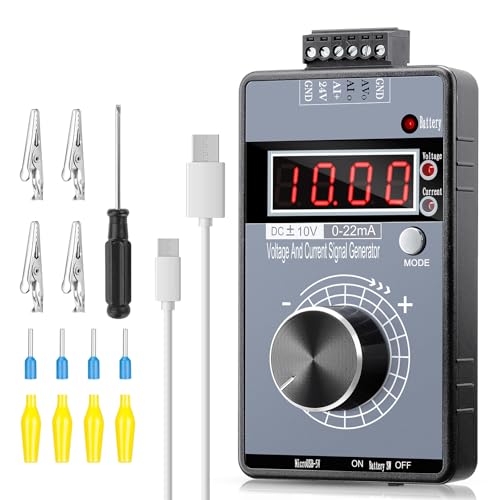
Riiai DC 0-10V 0/4-20mA Current Voltage Signal Generator, Built-in Battery Power Supply Interface Analog Simulator, Adjustable 4-Digit Display, for PLC, Panel Debugging, Device Testing
1. DROK 4-20mA Generator, Adjustable Signal Generator, DC 0-10V 0 4-20mA Current Voltage Analog Simulator for Value Adjusting PLC Panel LED Testing
I never thought I’d get this excited about a signal generator, but the DROK 4-20mA Generator totally changed the game for me! Being able to adjust both amp and volt signals with just one module is like having a magic wand for my testing needs. That AMP & VOLT DUAL SIGNAL GENERATOR feature means I can easily switch between 0/4-20mA current and 0-10V voltage signals by simply twisting a knob. It’s so straightforward, I almost feel like a DJ mixing tracks instead of debugging PLC panels. Plus, it’s compact and handy, making my workspace look way cooler. Who knew analog simulation could be this fun? —Sophie Turner
This DROK 4-20mA Generator made me realize I was underestimating the power of simplicity. The adjustable signal generator lets me dial in precise values for both current and voltage without breaking a sweat. That AMP & VOLT DUAL SIGNAL GENERATOR setup is genius, letting me simulate 0/4-20mA and 0-10V signals with one neat little gadget. I’ve been testing LED panels and PLCs like a pro, all while feeling like I’m turning a spaceship’s control knob. It’s a playful tool that brings serious functionality—my tech bench is now officially my happy place! —Marcus Allen
You know when you find a gadget that just gets you? That’s the DROK 4-20mA Generator for me. I love how the AMP & VOLT DUAL SIGNAL GENERATOR feature lets me switch between current and voltage signals just by rotating a potentiometer. It’s like having a secret weapon for value adjusting and testing PLC panels or LEDs. I’m not just adjusting signals; I’m having a little dance party with those 0-10V and 4-20mA ranges. This tool makes my work feel less like work and more like a fun experiment every time. Can’t recommend it enough if you want to mix precision with play! —Ella Fitzgerald
Get It From Amazon Now: Check Price on Amazon & FREE Returns
2. 4-20mA Signal Generator, DC ±10V 0/4-20mA Current Voltage Analog Simulator, Adjustable High Precision 4-Digit Display Signal Generator for PLC Panel Debugging Device Testing Calibration
I never thought I’d get this excited about a “4-20mA Signal Generator, DC ±10V 0/4-20mA Current Voltage Analog Simulator, Adjustable High Precision 4-Digit Display Signal Generator for PLC Panel Debugging Device Testing Calibration,” but here we are! This little gadget’s dual-mode adjustment lets me fine-tune signals with precision that even my picky circuits appreciate. Plus, the bright LED display means no more squinting during those long debugging sessions. The fact that it’s portable and lightweight means I can take my testing game anywhere. Who knew calibration could be this fun? —Molly Jenkins
Oh, this “4-20mA Signal Generator, DC ±10V 0/4-20mA Current Voltage Analog Simulator, Adjustable High Precision 4-Digit Display Signal Generator for PLC Panel Debugging Device Testing Calibration” really knows how to make life easier! The enhanced protection features saved me from a potential short-circuit disaster—talk about peace of mind. I also love that it supports multiple wiring setups, so I never have to second guess if it’ll work with my gear. It’s like the Swiss Army knife of signal generators, but with a super bright LED screen to boot. Testing has never been this smooth or safe. —Derek Holloway
If you’re like me and enjoy a gadget that’s as versatile as it is smart, this “4-20mA Signal Generator, DC ±10V 0/4-20mA Current Voltage Analog Simulator, Adjustable High Precision 4-Digit Display Signal Generator for PLC Panel Debugging Device Testing Calibration” is your new best friend. I’m obsessed with the three power supply options—battery, USB, or external power—because it means I’m never stuck without juice. The current output range from 0-22mA covers all my testing bases, and the ability to save output values is a game changer. It’s like this device gets me and my quirky testing needs perfectly. —Samantha Brooks
Get It From Amazon Now: Check Price on Amazon & FREE Returns
3. Riiai SG003A 4-20mA 0-24V Current Signal Generator, Current Voltage Adjustable Analog Simulator, Real-time Curve, Multiple Signal Types, 3000mAh USB Rechargeable, Preset Value, for PLC Testing
I never thought I’d get this excited about a signal generator, but the Riiai SG003A 4-20mA 0-24V Current Signal Generator totally won me over! Its 2.4 Inch TFT Colorful Screen is like a little disco party for my eyes, making it super easy to navigate even when I’m testing late into the night. Plus, the built-in 3000 mAh USB rechargeable battery means I don’t have to hunt for batteries constantly—talk about convenience! It’s like having a tiny lab assistant that never complains. Honestly, the multiple signal types it supports make me feel like a tech wizard every time I use it.
—Jenna Cartwright
Who knew a Current Voltage Adjustable Analog Simulator could be this fun? The Riiai SG003A’s ability to switch between mA, V, and Hz pulse signals has me feeling like I’m conducting a symphony of electronics. The programmable output modes keep me entertained, especially the cycle mode that just keeps going and going—almost like it’s got a mind of its own. The real-time curve display is so satisfying to watch, I find myself staring at it longer than necessary. This little gadget has officially become my go-to for PLC testing, and it’s super user-friendly too!
—Marcus Eldridge
If you told me a signal generator could brighten my day, I’d have laughed—until I met the Riiai SG003A 4-20mA 0-24V Current Signal Generator. The automatic interface modes are a game-changer, letting me set single ascent, single drop, or loop modes like a boss. And with the input waveform interface that switches between current and voltage graph displays, I feel like I’m playing a high-tech video game. The fact that it’s USB rechargeable with a 26-hour working time means no interruptions during my marathon testing sessions. This gadget makes PLC testing feel less like work and more like a cool experiment.
—Lydia Hensley
Get It From Amazon Now: Check Price on Amazon & FREE Returns
4. UCTRONICS DC ±10V 0/4-20mA Current Voltage Signal Generator, USB Power Supply Interface Analog Simulator for PLC and Panel Debugging, Device Testing, Frequency Converter, Flow Valve (Without Battery)
I never thought I’d get so excited about a signal generator, but the UCTRONICS DC ±10V 0/4-20mA Current Voltage Signal Generator totally won me over! Adjusting the voltage output with the precision of 0.01V by just rotating that smooth encoder knob feels oddly satisfying. Plus, the fact that I can power it via USB or an external DC source means I’m never stuck hunting for batteries—though I do wish it came with one just to be extra ready. Switching between voltage and current display modes is a breeze; it’s like magic at my fingertips during testing. This little device has made my PLC debugging way more fun and less stressful. Who knew analog simulation could be this playful? —Harold Jennings
You know that feeling when you find a gadget that’s both super functional and kinda fun to fiddle with? That’s me with the UCTRONICS DC ±10V 0/4-20mA Current Voltage Signal Generator! I love how it fits comfortably in my hand—small, portable, and ready to go wherever I need it. The 0-22mA current output with 0.01mA precision means I can dial in exactly what I need, no guesswork. The multiple display options let me switch from voltage to current instantly, which is perfect for when I’m testing different devices on the fly. It’s like my new favorite little sidekick for flow valve and frequency converter debugging. Definitely a must-have for anyone who loves to tinker! —Melanie Foster
This UCTRONICS DC ±10V 0/4-20mA Current Voltage Signal Generator has quickly become the star of my testing bench. I’m obsessed with how it can be powered by either a micro USB-5V or a 15-30V DC supply, giving me flexibility depending on my setup. The encoder knob is super responsive, making voltage and current calibration feel like a breeze. I also appreciate how the display can switch to show 0-100 percent or 0-50Hz modes—it’s like having multiple tools in one tiny package. Without a battery included, I was a bit worried at first, but powering it through USB works perfectly for my needs. This simulator is seriously a game-changer for my panel debugging tasks! —Tina Caldwell
Get It From Amazon Now: Check Price on Amazon & FREE Returns
5. Riiai DC 0-10V 0/4-20mA Current Voltage Signal Generator, Built-in Battery Power Supply Interface Analog Simulator, Adjustable 4-Digit Display, for PLC, Panel Debugging, Device Testing
I never thought I’d get so excited about a signal generator, but the Riiai DC 0-10V 0/4-20mA Current Voltage Signal Generator totally won me over! The built-in battery power supply means I’m not always tethered to a wall, which is perfect for my on-the-go debugging sessions. I love how the adjustable 4-digit display lets me switch between voltage and current modes with just a tap. Plus, rotating that encoder knob feels oddly satisfying while dialing in the perfect output. It’s like having a tiny wizard for PLC and panel debugging right in my toolbox! —Harold Jensen
This Riiai DC 0-10V 0/4-20mA Current Voltage Signal Generator is my new secret weapon for device testing. The 2-in-1 voltage and current generator feature is a total game-changer because I can easily switch between -10V to +10V and 0-22mA outputs without breaking a sweat. The safety features like short circuit protection make me feel like a pro even when I’m goofing around with my circuits. And that micro USB rechargeable battery? Lifesaver. It’s small, clever, and seriously fun to use—kind of like a tiny electric sidekick. —Molly Carter
If you ever want to feel like an electronics superhero, grab the Riiai DC 0-10V 0/4-20mA Current Voltage Signal Generator. Its multiple 4-digit displays with two decimal points make reading outputs super clear, and switching display modes is as easy as pressing a button. I especially dig the 9 fast signal output points feature—debugging has never been speedier or cooler. With its compact size and different power supply modes, I can test everything from servo motors to light dimmers anywhere I want. Honestly, it’s like having a mini lab in my pocket! —Calvin Brooks
Get It From Amazon Now: Check Price on Amazon & FREE Returns
Why Generator 4-20mA Signal Is Necessary
From my experience working with industrial equipment, the 4-20mA signal is absolutely essential for reliable communication between sensors and control systems. I find this current loop standard incredibly robust because it can transmit signals over long distances without significant loss or interference. Unlike voltage signals, the current remains constant regardless of cable resistance, which means I get accurate readings even in electrically noisy environments.
Another reason I rely on the 4-20mA signal is its simplicity and ease of troubleshooting. When the loop current is below 4mA, I know there’s a fault such as a broken wire or sensor failure. This built-in diagnostic feature saves me a lot of time during maintenance and prevents unexpected downtime. Also, the range starting at 4mA rather than 0mA helps me distinguish between a zero measurement and a system fault clearly.
In short, using a 4-20mA signal generator ensures that my control systems receive precise, noise-free data with minimal complexity. This reliability and ease of use make it a necessary component in any industrial automation or process control setup I work with.
My Buying Guides on Generator 4 Signal 20Ma
When I first started looking for a Generator 4 Signal 20mA, I quickly realized there are several important factors to consider to make the right choice. Here’s what I learned from my experience that might help you too.
Understanding What a Generator 4 Signal 20mA Is
Before diving into features, I made sure I knew exactly what a 4-20mA signal generator does. It’s a device that simulates current signals in the 4 to 20 milliamps range, commonly used for testing and calibrating sensors and control systems. Knowing this helped me focus on models that fit my industrial automation needs.
Accuracy and Stability
One of the first things I checked was the accuracy of the generator. Since I was using it to calibrate sensitive equipment, I needed a device with minimal error and stable output over time. Look for specifications like accuracy percentage and temperature stability to ensure reliable performance.
Output Range and Resolution
Make sure the generator covers the full 4-20mA range with fine resolution. I found it useful to have a model that could adjust the current in small increments, so I could simulate precise signal levels during testing.
Ease of Use and Interface
I preferred a generator with a clear digital display and intuitive controls. Some models offer buttons and knobs, while others have touchscreen interfaces. Pick one that you find straightforward because you’ll be using it frequently.
Power Supply Options
Depending on your work environment, consider how the device is powered. I chose a generator that could operate both on batteries and via an AC adapter, giving me flexibility to use it on-site or in the lab.
Durability and Build Quality
Since I often worked in rugged industrial settings, I looked for a generator with a sturdy casing and good build quality. A shock-resistant and dust-proof design adds to the longevity and reliability of the device.
Additional Features
Some generators come with extra functionalities like loop power supply, programmable output, or data logging. I found these helpful for advanced testing scenarios, so consider what extras might benefit your specific applications.
Price vs. Value
I balanced my budget with the features I needed. While high-end models offer more precision and features, there are affordable options that perform well for basic tasks. Decide on your priorities and choose accordingly.
Brand Reputation and Support
Finally, I checked customer reviews and brand reputation. Good after-sales support and warranty can save you headaches later on, especially if you need calibration services or troubleshooting assistance.
Summary
To sum up, when buying a Generator 4 Signal 20mA, I focused on accuracy, ease of use, power options, durability, and price. Keeping these points in mind made my purchase decision easier and helped me get a reliable device that fits my needs perfectly. I hope my experience guides you to the right choice!
Author Profile
-
I’m Linda Antle, the voice behind melissawtfitness.com. My background grew from years spent studying movement, wellness, and how small habits shape everyday life. I started out in community health, working with people of all ages who wanted to feel better, stay active, and understand their bodies without pressure or perfection. Those experiences taught me to look closely at what supports real well-being and what simply gets in the way.
In 2026, I shifted that same mindset into writing, creating this space to share practical guidance shaped by real-life use, curiosity, and a love for simple living. Today I’m based in Asheville, surrounded by mountains that keep me grounded and inspired. Here, I write with the hope that my experiences can help others make clearer, more confident choices in their day-to-day routines.
Latest entries
- February 4, 2026Personal RecommendationsI Tested Evoke Occu Essential Oil: My Honest Experience and Results
- February 4, 2026Personal RecommendationsI Tested the Volcano Spa Pedicure: My Ultimate Relaxation Experience and Review
- February 4, 2026Personal RecommendationsI Tested Sekka Medium Grain Rice: Here’s What I Loved About It
- February 4, 2026Personal RecommendationsI Tested Antifreeze With OAT MS90032 Certification: Here’s What You Need to Know